Commercial Window Film in Arizona: The Complete Guide to Heat, Glare, Privacy & ROI
How Phoenix, Scottsdale, and Valley property teams use solar tint, frost, safety film, and PDLC to cut heat load, protect interiors, and keep tenants comfortable — without replacing glass.
Topics: commercial window film Arizona · commercial window tint Phoenix · solar window film Scottsdale · office glare reduction film · building window tint Arizona · commercial frost film conference rooms · decorative privacy film · PDLC switchable privacy film
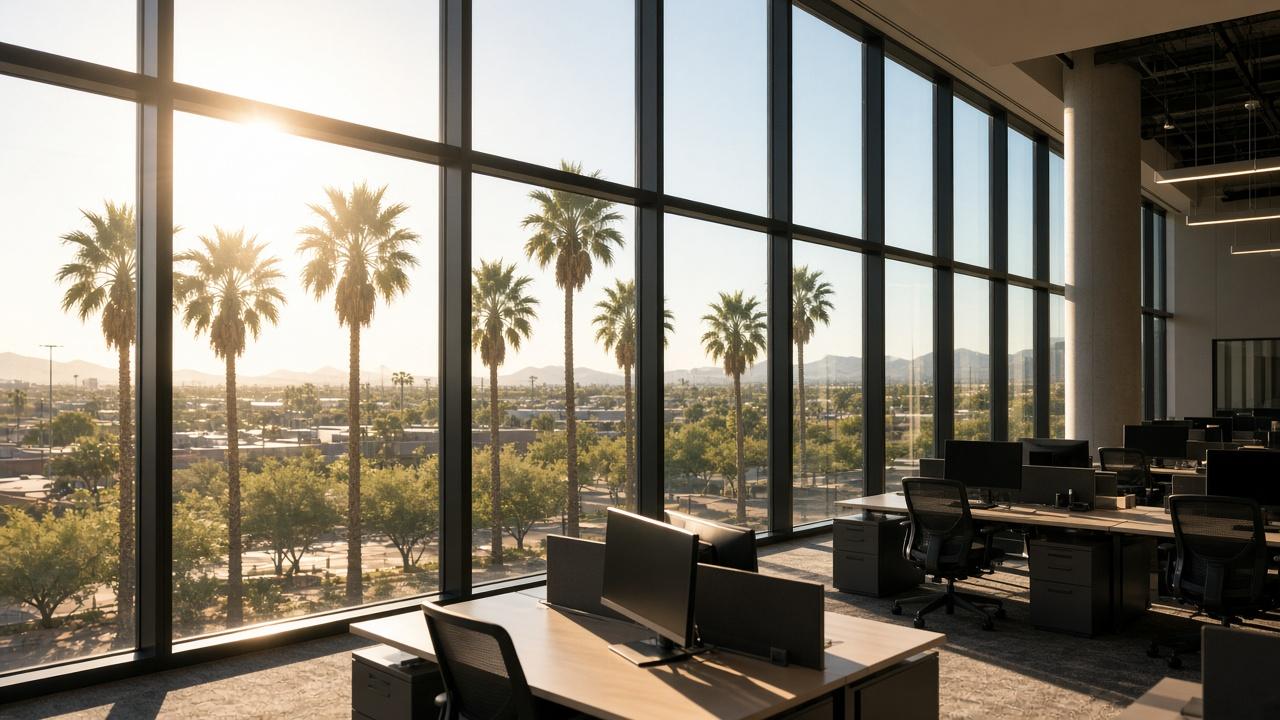
Arizona commercial buildings live under a different set of rules than most of the country. West-facing curtain walls in Phoenix and Scottsdale can turn perimeter offices into greenhouses by mid-afternoon. Storefronts along Camelback, Scottsdale Road, Tempe Mill, and downtown Mesa corridors bake through single-pane and older insulated glass. Conference rooms with full glass walls look premium — until every whiteboard session is visible from the hallway.
Commercial window film in Arizona is the fastest, lowest-disruption way to fix solar heat gain, office glare, UV fade, privacy, and smash-and-grab risk without replacing glass, shutting down HVAC, or hanging blinds that kill daylight. This guide covers what property managers, general contractors, tenant-improvement teams, and facilities directors across the Valley ask about most — with practical selection criteria, ROI framing, and install expectations from FilmTeq Commercial Films.
1. Why Arizona commercial glass is different
The Valley gets more than 300 sunny days a year. That is great for outdoor dining and rooftop amenities. It is hard on glass-heavy offices, medical suites, retail, and schools in Phoenix, Scottsdale, Chandler, and Gilbert. Three climate factors show up on almost every FilmTeq walkthrough:
- Extreme solar load on west and south elevations. Afternoon sun hits low and hard. Occupants close blinds; HVAC fights hot zones; energy bills climb on peak summer afternoons.
- High UV intensity year-round. Ultraviolet exposure fades flooring, furniture, and merchandise faster than in milder climates — especially near floor-to-ceiling commercial glass.
- Glare on screens is a productivity complaint. Open offices, trading floors, and classrooms near glass lose usable desk space unless glare reduction film controls the problem at the glass — not with temporary shades.
Replacing glass with high-performance IGUs can work on major renovations. For occupied buildings, window film for commercial buildings is usually the better first move: lower capital cost than glass replacement, faster schedule, and measurable comfort gains along the glass line.
2. Five commercial window film types (and when each wins)
Not all “tint” is the same. Speccing the wrong product is how teams end up with too-dark storefronts, privacy that disappears at night, or security film that does nothing for heat. Use this map when comparing commercial window film options in Arizona:
1) Solar / spectrally selective window tint
Designed to reject infrared heat and cut glare while keeping more visible light than older dyed films. Best for offices, classrooms, lobbies, and west-facing curtain walls across the Phoenix metro.
- Common project names: solar window film, commercial window tint Phoenix, heat-control film, spectrally selective film
- Primary wins: cooler perimeter seats, less monitor washout, lower peak AC load
- Watch-outs: match Visible Light Transmission (VLT) to brand standards and HOA/landlord rules
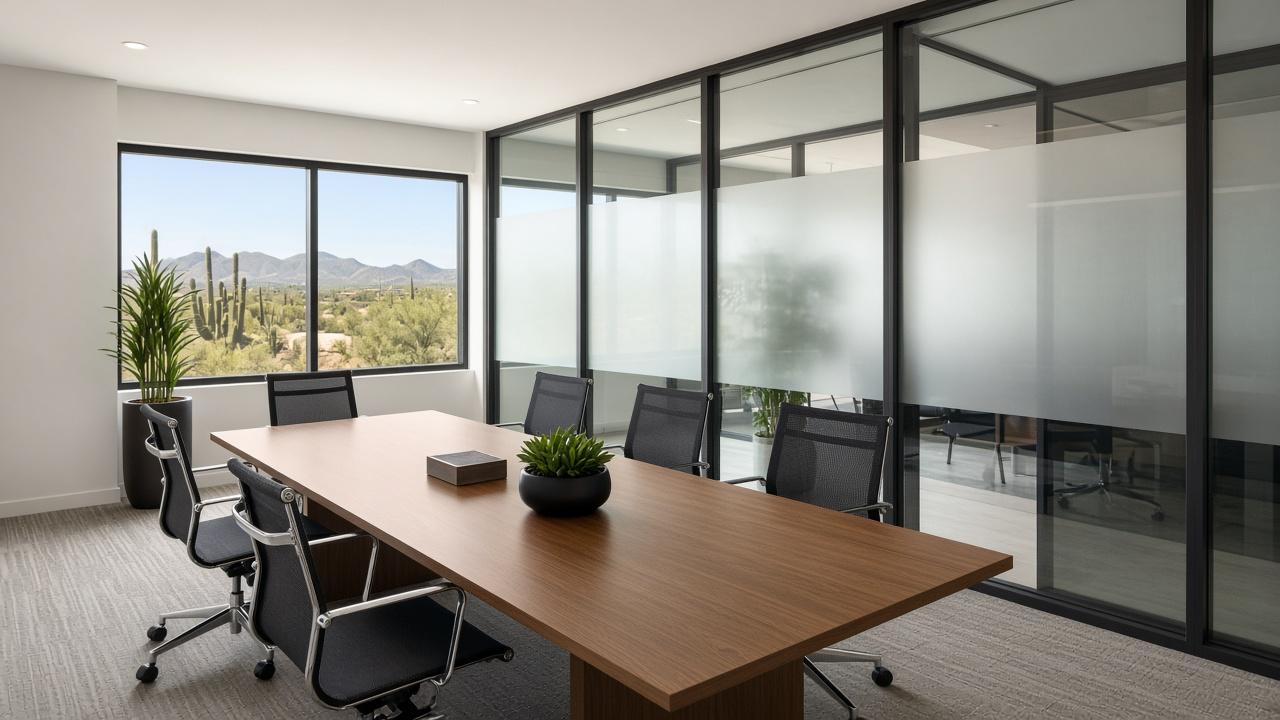
2) Decorative frost & graphic film
Etched-look or matte privacy film for conference rooms, clinics, restrooms, and interior partition glass. Can include frost bands, gradients, logos, and wayfinding graphics.
- Primary wins: meeting privacy, glass-visibility marking, brand-forward interiors
- Best for: tenant improvements, medical offices, coworking, law firms
3) Reflective / one-way daytime privacy film
Useful for street-level suites and storefronts that need daytime privacy without full frost. Performance depends on lighting balance — brighter outside than inside — a common condition on Arizona ground-floor glass.
4) Safety & security film
Thick polyester security window films that hold shattered glass together. Specified for smash-and-grab resistance, storm debris, and forced-entry delay on doors and display windows.
5) PDLC switchable smart film
Electronic privacy film that flips from frosted to clear on demand. Ideal for boardrooms, exam rooms, and executive offices that need glass aesthetics and on-demand privacy without blinds.
3. Heat, glare & HVAC ROI — the numbers decision-makers want
Facility and ownership teams usually care about three measurable outcomes from commercial solar film in Arizona — especially on west and south glass where solar heat gain drives both discomfort and peak HVAC demand:
- Glare reduction
- Up to ~87%
- UV rejection
- Up to 99%
- Comfort zone
- Cooler glass line
Exact rejection percentages depend on glass type (single, dual, low-E), film series, and orientation. What matters for ROI conversations on commercial window film installation:
- Peak load relief on the glass line. Perimeter zones stop overcooling the core just to keep west desks livable during Arizona summers.
- Higher usable seat count. Desks that were abandoned near windows come back online — often cheaper than leasing more square footage.
- Furniture and finish protection. UV-protection commercial film slows fade on flooring, millwork, and inventory near storefront glass.
- CapEx avoidance vs. glass replacement. Window film cost is typically a fraction of replacing curtain-wall or storefront glass and avoids multi-week disruption.
4. Privacy without blinds: frost, bands, and PDLC
Blinds and curtains solve privacy by blocking light. Arizona teams usually want the opposite: keep daylight, hide the meeting. Three patterns show up repeatedly on FilmTeq commercial frost-film projects:
- Full frost privacy film — exam rooms, restrooms, HR offices, lactation rooms.
- Frost bands / gradients — conference rooms that need seated privacy while keeping open sightlines above eye level.
- PDLC switchable smart film — spaces that alternate between collaboration (clear) and confidential review (opaque) in the same hour.
Decorative film also helps with glass visibility marking requirements so people do not walk into clear partition doors — a common tenant-improvement punch-list item on Arizona TI packages.
Want a film recommendation for your elevation?
Send building type, orientation (N/S/E/W), and a few photos if you have them. We’ll reply with a practical film shortlist for Phoenix-metro glass.
5. Safety film for storefronts and smash-and-grab risk
Retail corridors, jewelry and electronics displays, pharmacy glass, and ground-floor lobbies are frequent targets. Security window film in Arizona does not make glass unbreakable — it holds shards together and slows entry long enough for alarms and response.
- Often paired with door hardware upgrades and alarm contacts
- Can be clear (near-invisible) or combined with solar window tint
- Common on Arizona strip centers, boutiques, and street-level medical suites
6. Where commercial film pays off fastest in Arizona
Priority ranking based on typical Valley project payback and complaint volume for commercial window tint and privacy film:
- Class A / Class B offices with west glass — glare tickets and hot desks drive the work order.
- Medical & dental suites — privacy film + solar control on waiting rooms and treatment areas.
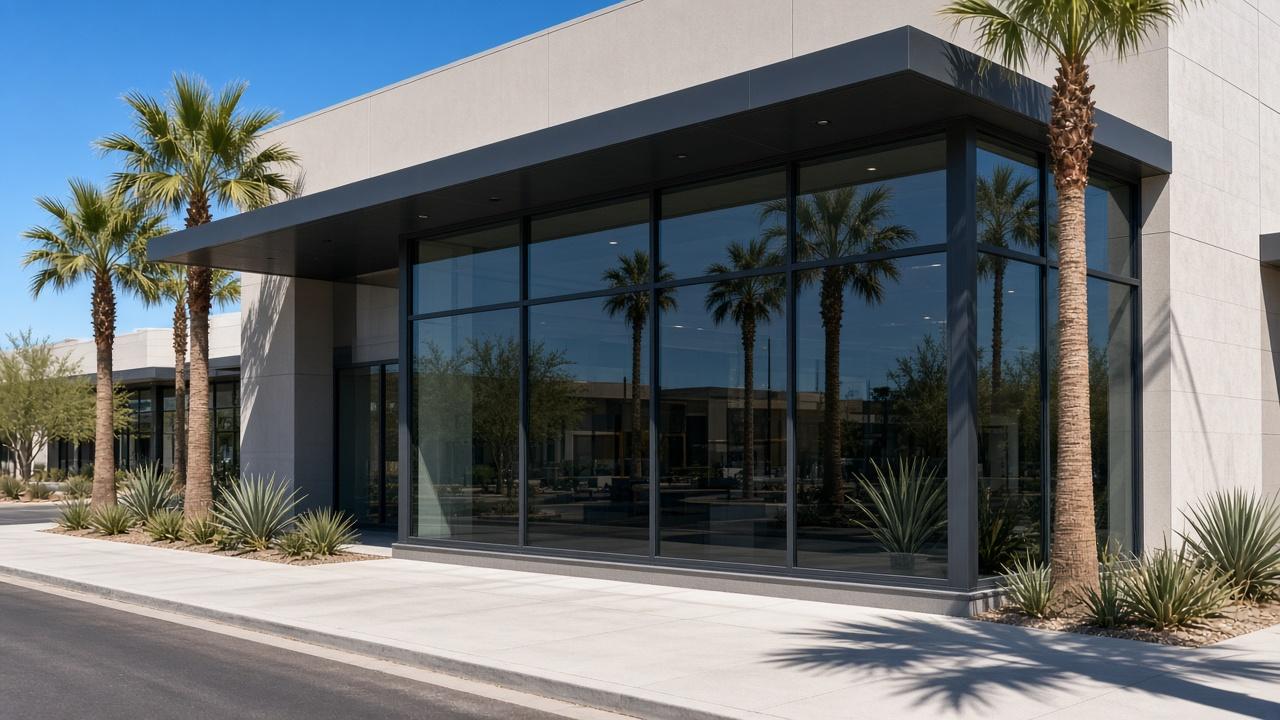
- Retail storefronts — merchandise fade, AC short-cycling, and security film on display glass.
- Schools & training centers — classroom glare and UV on flooring.
- Hospitality & multifamily amenities — pool-facing glass, lobby glare, and decorative privacy in shared spaces.
- Industrial / flex with curtain walls — front-of- house comfort without full HVAC redesign.
7. How to choose the right commercial window film
Use this checklist on the walkthrough (or send it with your RFQ for Arizona commercial window film installation):
- Orientation: note N/S/E/W and any reflected glare from adjacent buildings.
- Glass construction: single, dual, low-E, tempered, laminated — film must be compatible.
- Primary job: heat, glare, privacy, security, or aesthetics (rank 1–2 goals).
- Brand / landlord VLT rules: especially for storefronts and HOA-controlled campuses.
- Occupancy: after-hours install may be required for active suites.
- Warranty & maintenance: professional install matters as much as film brand.
8. What a commercial install looks like
A typical FilmTeq Commercial Films project flow for commercial window film installation in Arizona:
- Walkthrough and glass survey (often within 2 business days of inquiry)
- Fixed, line-item quote — film type, square footage, schedule notes
- Surface prep, precision cutting, and wet install
- Squeegee finish, edge detailing, and quality pass
- Cure window (keep film dry; avoid scraping) — team briefs on-site contacts
Most suite-level jobs finish in 1–3 days. Larger multi-floor curtain walls phase by elevation or floor so tenants stay operational. Pre-summer installs are popular, but FilmTeq crews work year-round across the Phoenix metro.
9. FAQ for GCs, property managers & facilities teams
Straight answers to the questions Arizona GCs, property managers, and facilities teams ask most about commercial window film, solar tint, frost, security film, and PDLC:
Does commercial window film work on low-E glass in Arizona?
Yes — commercial window film can work on low-E and dual-pane glass when the correct product is specified for the glass construction and climate. Some film-and-glass combinations need careful selection to avoid thermal stress on sealed units. A Phoenix-area site survey beats a catalog guess and confirms compatibility before install.
Will solar window tint make our Phoenix storefront too dark?
Only if you choose an aggressively low Visible Light Transmission (VLT) product. Modern spectrally selective solar window film can cut heat and glare on Arizona storefronts while preserving a bright, open look that still showcases merchandise. FilmTeq matches VLT to landlord, brand, and HOA rules before quoting.
Can commercial window film be installed during business hours?
Often yes for vacant suites, after-hours corridors, or low-traffic zones. Occupied medical floors and open offices in Phoenix and Scottsdale frequently prefer early-morning or evening crews so tenants stay productive. FilmTeq schedules around your building’s access rules and can phase multi-floor curtain walls by elevation.
How long does commercial window film last in Arizona sun?
Quality commercial window films installed correctly commonly deliver many years of service under Arizona UV and heat when edge work and surface prep are done right. Manufacturer warranties and install warranties should be reviewed on the quote, along with cleaning guidance for facilities teams. Longevity also depends on glass type, elevation, and whether the film is solar, frost, security, or PDLC.
Is PDLC switchable smart film worth it vs. static frost film?
Choose decorative frost film when privacy needs are constant — exam rooms, restrooms, and many conference partitions. Choose PDLC switchable privacy film when the same room must flip between clear collaboration glass and opaque confidentiality without blinds. In Arizona tenant improvements, PDLC is most often specified for boardrooms, executive offices, and clinical consult rooms that change use throughout the day.
How much does commercial window film cost vs. replacing glass?
Commercial window film is typically a fraction of the capital cost of replacing storefront or curtain-wall glass, and it avoids multi-week disruption in occupied buildings. Exact pricing depends on film type, square footage, access, and whether you need solar tint, frost, security film, or PDLC. A FilmTeq walkthrough produces a fixed, line-item quote — with first-order savings of up to $1,000 on qualifying projects.
What cities does FilmTeq Commercial Films serve in Arizona?
FilmTeq installs commercial window tint, decorative frost, security film, and PDLC across Phoenix, Scottsdale, Tempe, Mesa, Chandler, Gilbert, Glendale, Peoria, and surrounding Arizona markets. Projects cover offices, retail storefronts, medical and dental suites, education, hospitality, and tenant-improvement glass. If your building is in the greater Phoenix metro, we can usually schedule a walkthrough within two business days.
Spec-ready takeaway
For Arizona commercial glass, start with solar control film on heat-loaded elevations, add frost or PDLC where sightlines matter, and specify security window film on smash-prone openings. FilmTeq Commercial Films provides walkthroughs, line-item quotes, and after-hours crews built for occupied suites in Phoenix, Scottsdale, and the surrounding Valley — with first-order savings of up to $1,000.
Schedule your Arizona glass walkthrough
Offices, storefronts, medical suites, and TI glass — tell us what you’re working on and we’ll follow up within one business day.